
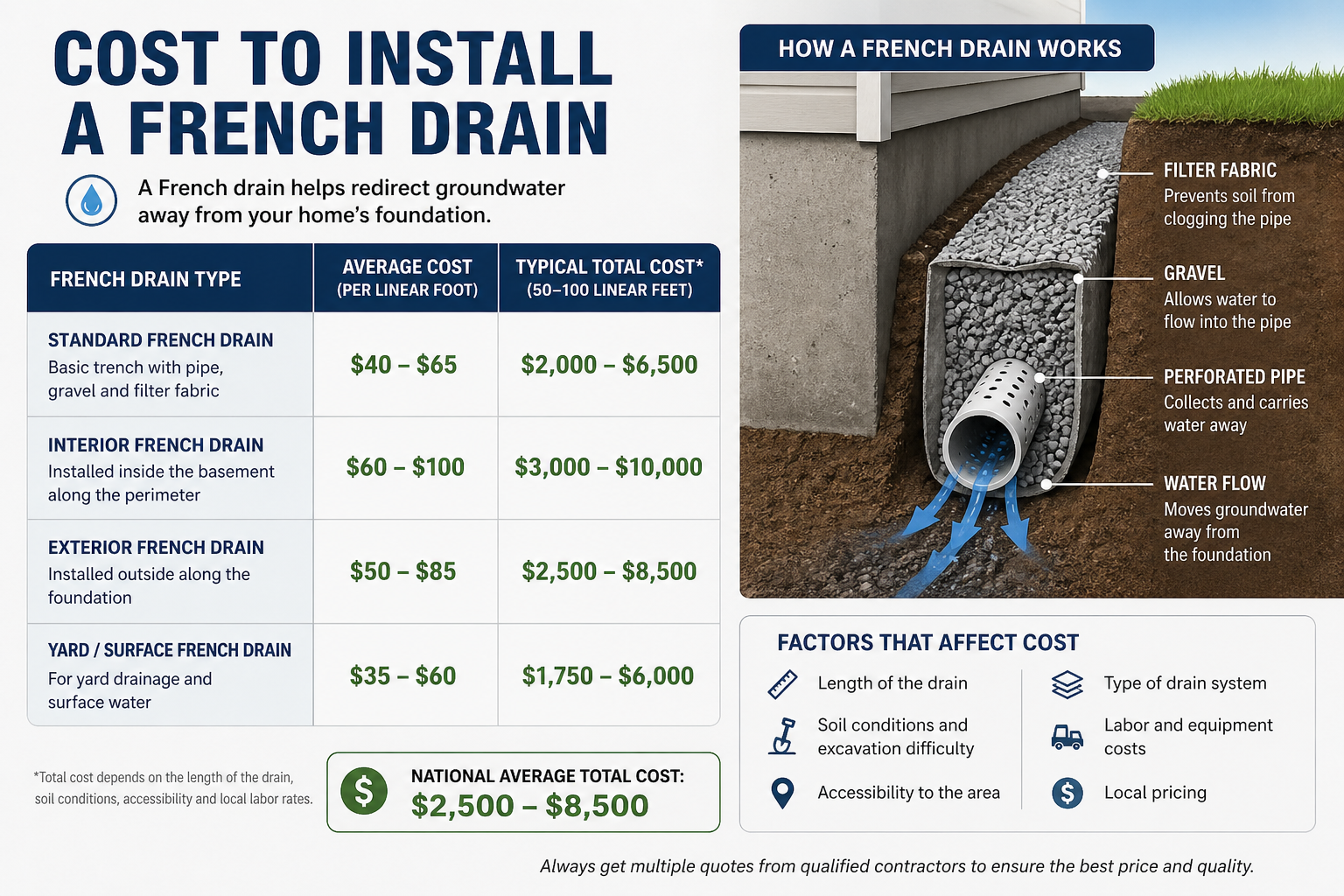
If water is pooling in your yard, seeping toward your foundation, or turning a corner of your lawn into a soggy mess every time it rains, a French drain is likely one of the first solutions a drainage contractor will recommend. Before you call for quotes, it helps to understand the cost to install a French drain — what drives the price, what separates a well-built system from a cheap one, and what you should expect to pay for a professional installation in the Indianapolis area.
At Homeward Environmental, we specialize in yard drainage solutions for Indianapolis homeowners — including French drains, buried downspouts, yard drains, retaining walls, and sod installation. We’ve assessed hundreds of drainage problems across Central Indiana, and no two properties are exactly alike. This guide gives you the honest, practical cost breakdown you need to make an informed decision before your free yard drainage inspection.
What Is a French Drain and How Does It Work?
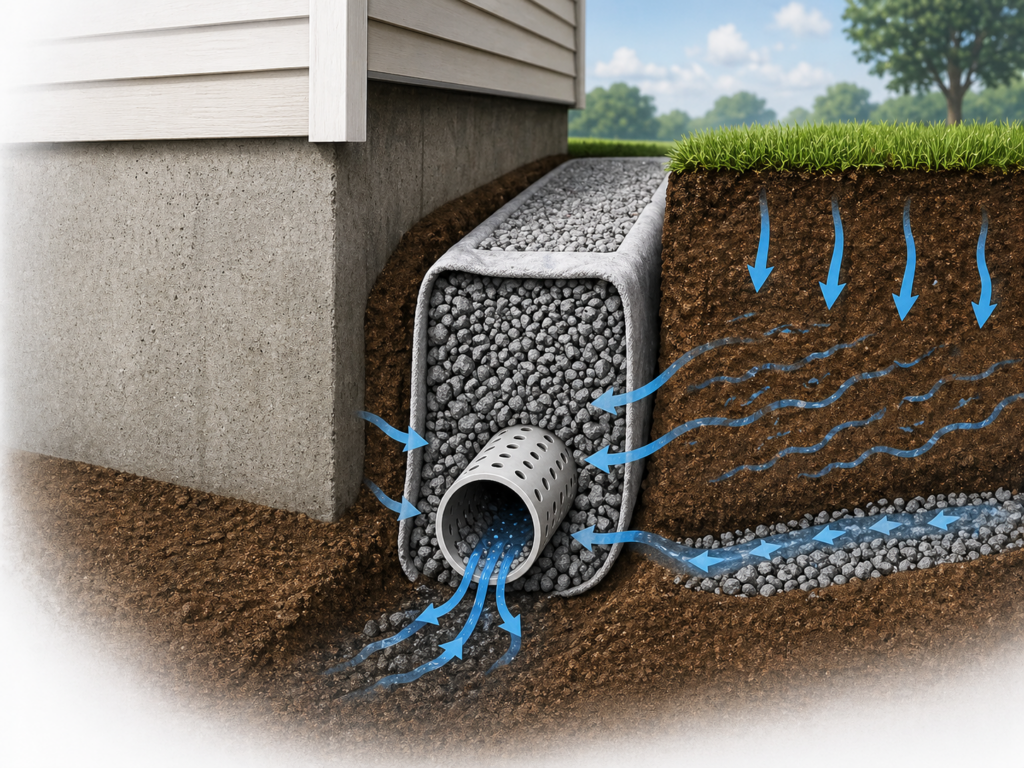
A French drain is a subsurface drainage system that redirects groundwater and surface water away from problem areas by channeling it through a gravel-filled trench lined with filter fabric and fitted with a perforated pipe. Water enters the system through the gravel and pipe, flows by gravity along a slight downhill slope, and exits at a designated discharge point — a street, storm drain, dry well, or lower area of the property.
The simplicity of the concept is part of what makes French drains so effective and durable when installed correctly. There are no moving parts, no electricity required, and no complex maintenance needs. When built with quality materials and proper slope, a well-installed French drain can manage significant volumes of groundwater and surface runoff year after year.
The catch — and the reason professional installation matters — is that the details make all the difference. Slope, depth, material quality, filter fabric selection, trench geometry, and discharge routing all affect how well and how long the system performs.
Key Factors That Determine French Drain Installation Cost
No single price applies to every French drain project because the variables that shape the cost are highly site-specific. Understanding what drives pricing helps you evaluate quotes accurately and avoid being misled by an unusually low number that may reflect a substandard system.
Total Linear Footage
The most straightforward cost driver is how long the drain needs to be. A short 20-foot run to address a single wet corner costs less than a 150-foot system routed around a home’s perimeter. Longer runs require more excavation labor, more pipe, more gravel, and more filter fabric — all of which scale directly with footage.
Soil Type and Conditions
Indianapolis-area soils vary significantly from property to property. Sandy or loamy soils are relatively easy to excavate; dense clay — which is common throughout Central Indiana — is harder to dig through, slows drainage, and sometimes requires deeper trenching or additional stone volume to compensate for poor natural permeability. Rocky or root-dense soil adds further excavation complexity and labor time.
Required Trench Depth
A surface drainage French drain addressing yard pooling may only need to be 18 to 24 inches deep. A system designed to intercept groundwater before it reaches a foundation or basement typically needs to be deeper — sometimes 36 to 48 inches or more. Deeper trenches require more excavation labor and more backfill material, and may require specialized equipment to dig safely.
Yard Access and Obstacles
Easy, open access to the work area keeps equipment and labor costs down. Narrow side yards, fencing that needs temporary removal, established landscaping, irrigation lines, hardscape features, and other obstacles all add complexity and time to the installation. The contractor’s equipment needs to reach the trench area, and finished landscaping needs to be protected or restored.
Discharge Location and Routing
Water that enters a French drain has to go somewhere. The difficulty and distance of routing the discharge line to an appropriate outlet — a curb, a storm drain inlet, a dry well, or a lower area of the property — affects both material and labor costs. Longer discharge runs, street connections requiring permits, or dry well excavation all add to the project total.
Material Quality
This is where French drain quotes can diverge significantly — and where the cheapest option frequently becomes the most expensive over time. A properly built French drain uses clean washed stone (not crushed fines that compact and restrict flow), quality perforated pipe, and non-woven filter fabric that allows water to pass while blocking sediment. Systems that skip filter fabric or use inadequate stone clog with sediment in a fraction of the time a properly built system would last.
Homeward Environmental’s French drain systems include permanent debris boxes and cleanouts installed every 50 feet, turf restrictor plates, and filter-lined square trenches with clean stone — components that make the system easier to maintain and designed to last 20 years. These features cost more upfront than a basic installation, but they protect the investment over the life of the system.
What’s Included in a Professional French Drain Installation
Understanding what a contractor should include in a complete French drain installation helps you compare quotes on equal footing. A thorough professional installation typically covers:
- On-site assessment and drainage planning: Identifying the source of the drainage problem, determining the optimal trench route and discharge point, and confirming the system will achieve the necessary slope for gravity flow.
- Utility location: Calling 811 (Indiana’s dig-safe service) before any excavation begins to locate underground utilities. This is non-negotiable for any legitimate contractor.
- Excavation: Trenching to the required depth and width along the planned route, with spoil removed from the property or stockpiled for backfill.
- Filter fabric installation: Lining the trench with non-woven geotextile fabric before stone is placed to prevent sediment migration into the gravel and pipe over time.
- Stone and pipe placement: Laying clean washed gravel, positioning perforated pipe at the correct slope, and wrapping or capping the system with fabric before backfilling.
- Debris boxes and cleanouts: Access points installed at regular intervals so the system can be inspected and flushed if needed — a key feature of long-lasting French drain installations.
- Discharge connection: Routing the outlet line to the designated discharge point and confirming proper flow.
- Surface restoration: Backfilling, tamping, and restoring the surface — whether lawn, mulch, or other finish material — to a clean finished condition.
French Drain vs. Other Drainage Solutions: Understanding the Cost Comparison
French drains are one of several drainage tools available to Indianapolis homeowners. Understanding how they compare in cost and application helps you make sense of what a contractor recommends for your specific situation.
| Drainage Solution | Best For | Relative Cost | Key Consideration |
|---|---|---|---|
| French Drain | Intercepting groundwater, redirecting yard runoff, foundation protection | Moderate to high depending on length and depth | Most effective for subsurface and widespread surface water problems |
| Buried Downspouts | Carrying roof runoff away from the foundation | Lower — typically shorter runs | Addresses roof water specifically; often combined with French drains |
| Yard / Surface Drains | Collecting pooled surface water at low points | Moderate | Works best when combined with underground pipe to discharge water |
| Regrading | Correcting slope that directs water toward the home | Variable — depends on volume of soil movement | Often a prerequisite or complement to other drainage systems |
| Retaining Walls | Managing slope, erosion, and water runoff on graded properties | Higher — structural installation | Homeward Environmental retaining walls backed by 25-year warranty |
For many Indianapolis properties, the most effective solution combines two or more of these approaches. A French drain addressing groundwater intrusion along the back of a home, paired with buried downspouts that carry roof runoff underground and away from the foundation, solves the problem more completely than either system alone. Homeward Environmental assesses the full drainage picture at every property — not just the most visible symptom — to recommend the right combination of solutions.
Why Cheap French Drain Quotes Often Cost More in the Long Run
It’s tempting to select the lowest quote when comparing drainage contractors, especially for a project that will be buried underground and invisible once complete. But the quality of a French drain installation is almost entirely hidden — you won’t be able to see whether filter fabric was used, whether the stone is clean, whether cleanouts were installed, or whether the pipe was laid at the correct slope until the system either works or fails years from now.
The most common reasons cheap French drain installations fail prematurely include:
- Omitting filter fabric, allowing sediment to migrate into the stone and pipe and clog the system within a few years
- Using crushed fines or inadequate stone that compacts over time and restricts flow
- Incorrect slope — too flat to drain by gravity, or pitched in the wrong direction
- Insufficient depth to intercept the actual source of the water
- No cleanouts or access points, making it impossible to diagnose or clear a blockage without excavating the system
A French drain that fails after three years and requires replacement costs significantly more than a properly built system that lasts twenty. When evaluating quotes, ask every contractor what materials they use, whether filter fabric is included, how they handle cleanouts, and what warranty they offer on the installation.
What the Free Homeward Environmental Yard Drainage Inspection Includes
Because no two drainage problems are identical, Homeward Environmental offers a free on-site yard drainage inspection for Indianapolis-area homeowners before providing a project quote. During the inspection, our team assesses the source and pattern of the drainage problem, evaluates soil conditions and yard grading, identifies the optimal system routing and discharge point, and discusses the full range of solutions appropriate for your property.
You’ll leave the inspection with a clear understanding of what’s causing your drainage issue, what solutions will fix it, and what a properly built system will cost — with no obligation to move forward.
Frequently Asked Questions About French Drain Installation Cost
How much does it cost to install a French drain?
French drain installation cost varies based on the length of the system, soil conditions, required depth, yard access, discharge routing, and material quality. In the Indianapolis area, costs range from a few hundred dollars for a short, simple run to several thousand for a longer system in challenging conditions. An on-site assessment is the most reliable way to receive an accurate quote for your specific property.
What factors affect the cost of a French drain installation?
The main cost drivers are total linear footage, soil type and hardness, required trench depth, yard access and obstacles, discharge location and routing, and material quality. Systems that include debris boxes, cleanouts every 50 feet, filter fabric, and clean stone cost more upfront but last significantly longer and require far less maintenance than basic installations.
How long does a French drain last?
A professionally installed French drain using quality materials — clean stone, filter fabric, and perforated pipe — can last 20 years or more. Systems that skip filter fabric or use inferior materials clog with sediment much sooner. Homeward Environmental’s French drain installations are designed to last 20 years and include permanent debris boxes and cleanouts at regular intervals for easy maintenance.
Can I install a French drain myself to save money?
DIY installation is possible for simple, shallow applications on flat ground with easy soil. However, most residential drainage problems involve grading complexity, soil variability, and discharge routing decisions that benefit significantly from professional assessment. Incorrect slope, insufficient depth, or wrong materials can result in a system that fails quickly or makes drainage worse. For most homeowners, professional installation is more cost-effective over the long term.
Does a French drain add value to my home?
Resolving an active drainage problem can meaningfully protect and support your home’s value by preventing foundation damage, erosion, and landscape deterioration — all of which reduce property value and generate costly repairs. Unresolved drainage issues are also a common flag in home inspections, so addressing them before listing can support a stronger sale.
Get an Accurate French Drain Cost for Your Indianapolis Property
The only way to know exactly what a French drain will cost for your yard is an on-site look at the problem. Pricing guides like this one give you a framework for understanding what shapes the cost and what to look for in a quality installation — but your property’s specific conditions are what determine the actual number.
Homeward Environmental offers free yard drainage inspections throughout Indianapolis and the surrounding area. Our team will assess your drainage problem, explain your options, and give you a transparent quote for a properly built system that’s designed to last. Call us at (317) 608-5033 or schedule your free inspection online — and stop letting water damage your yard and your home.